 After reading the ordeal Michael Casey has gone through by posting an image on his blog (after he jumped through the hoops of giving permission to the source), I started thinking about all the images I use (or would like to use) in presentations or on my blog. What if everyone received the same amount of heat by pulling off interesting images and using them in presentations or posts? Eeak! Thinking about the types of images that I usually use (or see) in presentations, they are generally images that capture a thought or a certain idea in a sharp way . I tend to use images of signs, angles, odd objects. Wait! I also take pictures like that (or at least try with my point and snap digital camera). While at the Computers in Libraries Conference in Washington, DC last week I thought, hmmm–I could share some of my own images and take even more, put them on my flickr account in a set and allow anyone to use them, no permission needed. After lunch I started doing just that. Snapping away images of signs, benches, buildings. Then I was stopped by the military and asked why I was taking so many pictures of buildings, signs, benches…you get where this is going. After some explaining, I went back to my hotel room and downloaded pictures I think could serve presenters and bloggers well. Not the most polished, but you’re welcome to use them! And please do. Free is good, so snap up some of these Free Use Photos. I’ve added more since DC and will continue. Here’s to freedom!
Uncategorized
Un-it!
Lately I find myself talking to a small circle of colleagues about “unn-ing” practices, programs and services. Through these past few months I’ve collected quite a few terms that I file in the mental “unclyclopedia.” So what is unn-ing all about? It’s about deformalizing, it’s about letting the group gathered bring the direction and meet the needs that are right in front of them. There is no formal agenda, but instead what I call an “ungenda” that allows the group to create the topics that they find more meaningful than a standard pre-made agenda.
My colleague, Jason, has been putting our conversations about “unning” in play. He’s been have much success with “unprogramming.” Take a look at his 3 part series about the ins-and-outs of his experience working in this manner on our Circle of Knowledge Blog.
What other things can we “un?”
Live from Computers in Libraries–D.C.

It’s been a whirlwind of discussion, dreaming and doing these past couple of days at CIL. Helene & I lead off the Innovation Track this morning with our presentation ‘Innovation Starts with “I”.’ Great turn out, input and questions from the group. We’ll get the presentation up along with the streaming vid soon. We were followed by Michael Stephens & Michael Casey who talked about creating truly transparent, honest and open libraries. Good stuff. Some key take-aways:
Be willing to talk
Talk honestly
Work toward truth, not perfection
“It’s not a age issue, it’s an effort issue.”
On the edge of wonder

Innovation is often more about taking what you have and adding a new ingredient than starting from scratch to create something new. What is a good ingredient to add to a standard program or service? Try “wonder.” What can we do to add an element of pure wonder into what we do each day–both for our users and our staff? My colleague Emily recently ventured into an arena of the common-gone-wonderful when she created and offered an unapologetic Noisy Storytime. Yes, a program that was consciously crafted to allow kids who want (and need) to make noise have their kind of experience. Working off an idea found in SLJ, she put it into action. We have the opportunity each day to inject our programs, services and tools with the element of wonder (you may call it delight, energy, newness) into what we do. It’s not always the easiest thing to do when we’re balancing the many plates of our day-to-day–yet possible. Take a look at Emily’s post on the Library in Action blog for inspiration. Need some other ways to stir the wonder into what you do? Try these to start:
1. Bring something strikingly beautiful into your space (office, workroom, lobby) and let it speak for itself.
2. Ask yourself: what would my program look like if I allowed “the audience” to run the show? Let at least some of it happen.
3. Allow a kid to teach you something. Even something you know how to do already.
What give you a feeling of “Wonder?” Move with that.
Wisdom from the streets of Minneapolis

While walking the streets of Minneapolis as the city gears for a full-on day of PLA, store windows shouted out truisms (and ploys to buy their spring lines). This truism was worthy of a snap.
Simple can be quite sublime.
As I move forward in this conference with a myriad of workshops, meetings, catch-ups and info to seek out, “Keep It Simple” sounds good right now.
What are you doing to keep it simple (and effective)?
Barriers, Freedom, Stickers?

I have recently been working on a presentation about intellectual freedom. Interesting in life when you are focusing on a subject or idea so many “illustrations” of it begin to appear around you–some monumental, some mundane–all mental-note worthy.
Picture me wading through manuals, articles, and online material in preparation to present information on intellectual freedom…when…poof…real-life appears before me. Real life in the form of a series of emails in which I find out that a few public libraries within hollering distance of where I am located are starting to sticker and/or relocate parts of their collections to designate them into levels to support the reading lists of a particular for-profit “incentive-based reading program” (er, let’s be fun and a little coy here and just say that the program starts with an “A” and ends with an “R.”) Cut to me, like a bolt of lightning out of the Library Heavens, running to find my intellectual freedom file of information. Pouring through my notes and print-outs I find the small phrase that cuts to the chase–“psychological barriers.” Think: it is not the intent of the Public Library to support or construct any psychological barriers for any readers. Easy enough to buy into right. And yet, alas, the thought of a collection of blue spine-stickered books (for the 4.5 readers) and yellow spine-stickered books (for the 2.4 readers) has psychological barrier written all over it.
An aside from the my-school-days memory box: Did we not learn anything from the “SRA Program” in the 70’s and 80’s? As a student who endured this during that time, I can say that yes, I learned one big lesson from it: Reading = Taking a test to prove you did the reading! Is that what we wish to support? How about Reading = discovery of self, the world, new information in the method, at the level, in the time that is right for the Individual and not at a $tandardized pace (yes, the “$” is intentional).
So, can a few hundred stickers really be barriers to reading freedom? Can’t they be seen as a support–as short-cut–for users to find what is required by their schools? Answer this question: If a user has 10 minutes to find books on a busy evening will they take the time or find the resource to lead them to that book on “coins of the world” their child really wants or choice from those which are pre-selected and marked or stickered with an “authorized” company’s leveling system? Are we talking about barriers or support here? Perhaps it’s a pretty grey area…but it becomes more clear to me with the stickers come out, a small psyco-barrier goes up.
Let reading freedom ring!
Where’s the Point?
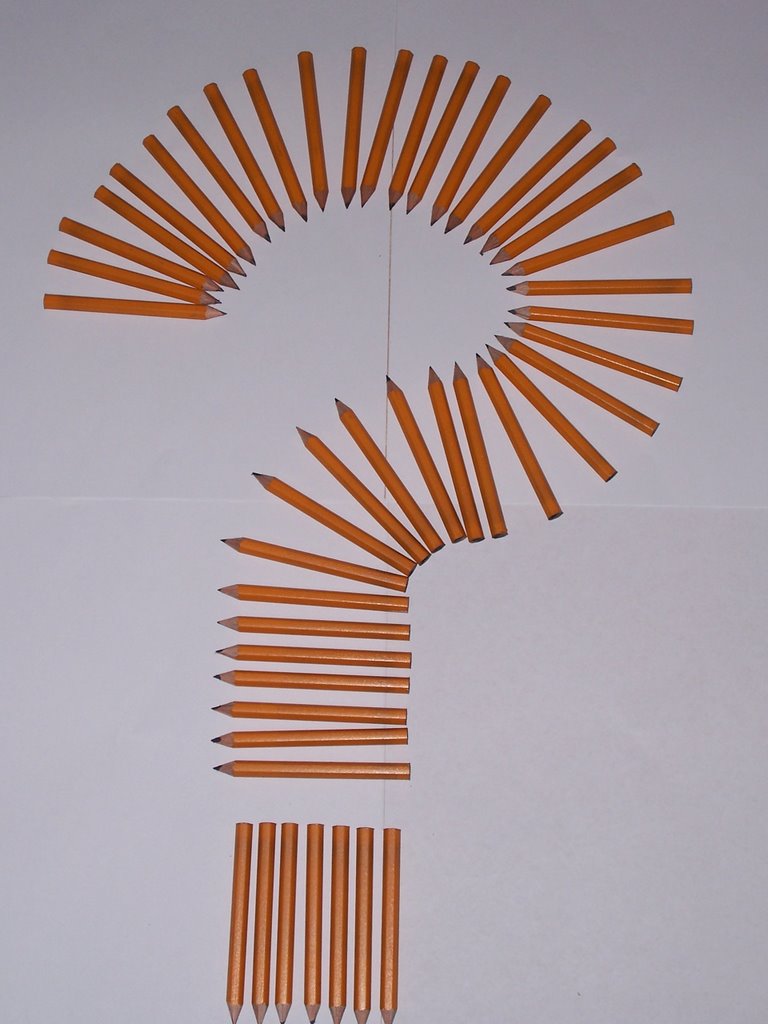
 I’m inclined to say there is no point…at least when it comes to these familiar little things–yes, the golf pencil, the mini-pencil, or the nubby pencil as Helene, a PLCMC collegue, told me she calls them today. Whatever you call them, I think they are a perfect little example of old ideas or practices that aren’t really serving us any more in libraries–at least not effectively. My point in their pointlessness is this: We pay money for these tiny little things that last perhaps for 2 or 3 usages and then wind up in the garbage can. You can’t sharpen them as they get lost or stuck in the pencil sharpener…they have no eraser and wind up being more of an annoyance than anything. As I was thinking about this, I looked at the pen in my own hand. It was a nice padded grip pen that I received free from a promotional products rep…I then I looked at the pencil cup on my desk and it is filled with dozens of unused pens and pencils… I look around the workroom in my department–dozens, perhaps hundreds of unused pencils and pens! And still we are paying for these tiny little bothersome yellow pencils! My curiosity deepened on this small topic, so I made a few calls and found out how much these items cost–for a box of them (114) retail = $14! Wholesale (a real steal) = $8! I can confidently say that the library where I work each day could easily go through a box or more of these a day! I’ll let you do the math. We’re talking thousands of dollars here folks. But how could anything replace our familiar golf pencils? They’re as Library as, say bookends? For starters, how about just bringing out some of those hundreds of pens and pencils floating around in all the drawers and cups and bins in our offices…or, hmmm, remember that pen I mentioned earlier that had the name of a product rep on it? Don’t you just know that they (or another local agency) would likely jump head over heals to have their pens with their logo and info used in a building that serves thousands of people daily. Even better, what if the Library took the thousands of dollars it’s spending on these short-lived items and had inexpensive pens or pencils printed. “Then people would take them…they’d walk out the door!”you say? My response:” Oh, no! That means we’d have pens with our logo and message floating all over the Charlotte region!” Not such a bad thing to happen, I say. This alternative has much more of a point than a $14 box of golf pencils. Get my point?
To comment on this post, click to the re-post of this blog here.
It’s 588–Wave Bye, Bye!

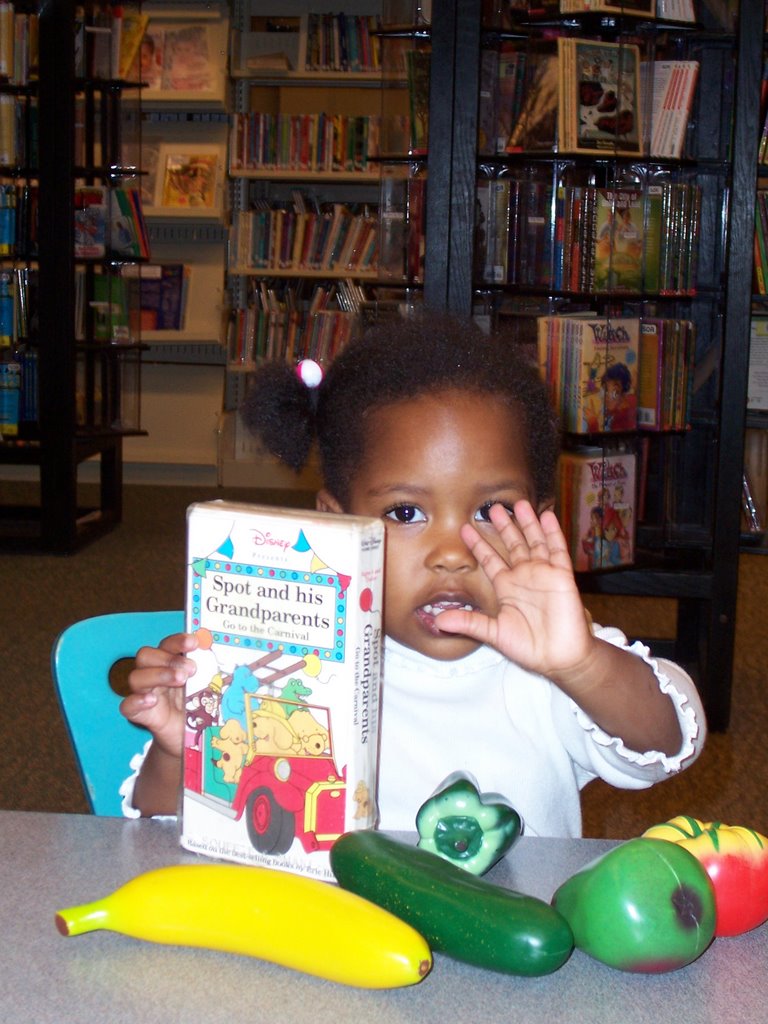 What’s so special about this little VHS? And why are we waving bye-bye to it? Well, this little trooper of a tape has circulated 588 times at South County Regional Library. That’s at least 588 VCR’s–many with multiple viewings…it’s Spot the Dog, after all. Big deal, you say, perhaps? Yes, really big deal. This afternoon when Joy, a staff member, brought this to my attention before it was withdrawn–long past its normal circulation cycle–I was wowwed back into thinking about how special libraries are. How much joy they bring to kids, adults, and all of us in between. This little Spot video that has served so many houses with entertainment, TV babysitting, and all that is wrapped up in the adventures of any yellow dog and his special brand of showmanship…deserves its moment of applause….and with it I applaud all the hands that have shelved it, checked it out, searched for it on shelves, zapped it into “play” or “renew.” 588…it’s a golden number…now wave, bye-bye, Spot.
A bit more about Grey Gardens…
|
Last week I bought the soundtrack to the musical ‘Grey Gardens.’ Alas, another landslide of revolutionary thoughts and Grey Gardens cyber research has kicked in…This piece tells a bit more about the story behind the story behind Grey Gardens… pretty standard, but informative at least. Here’s to the best costume for the day! |
|
Leaps of Trust?
 Why is there a question mark at the end of this posting title? Ideally, there wouldn’t be when we’re talking about trust–especially “radical trust” which has been talked about much in the past several months. And radical trust is what I want to talk about.
Just yesterday I read an article in SLJ called “A Matter of (Radical Trust).” Though I understand that the writer of this article was coming mostly from perspective of a public school setting, my reaction was one of “did he just say what I thought he said?” …and the sounds of a thousand balloons deflating could have been piped in as the soundtrack for the moment I read the last sentence. The writer begins his last paragraph by saying “…let me state very clearly that radical trust is just not going to work.” (Once again insert a thousand balloons deflating). If I recall correctly, the word “radical” is based in the word “root” which means foundation, fundamental, essential. So, essential (radical) trust is just not going to work? If this is the thougtht, then the brakes are pulled on 2.0, on building any type of deep relationship or partnership with library users and–perhaps more drastically–those who are not users (which we want to reach)–including the youth we serve.
I commented to Helene, a colleague, yesterday after reading the article that it made me think that the undercurrent of the message that is being sent here is like saying
“Sure, I trust you completely…well, except when you may have your own thoughts, or when you color outside the lines, or step outside of this little hermetically sealed bubble we’ve prepared for you…”
The authors suggested “moderated trust.” Isn’t this what has kept us at a snail’s pace while the 2.0 world blazed ahead?
Ultimately we can’t take leaps of faith (or trust) when we focus on what might jump up at us in mid-air!
 Yes to Know